





































Neon lights and art
The bizarre neon lights are not only the symbol of the city, but also the epitome of consumer culture. In 1898, William Ramsay, a famous Scottish chemist, discovered that this kind of gas would emit a special bright color in the discharge lamp while chasing the rare gas, and named it “neon”. Commonly used in commercials and shop signs, neon lights reached their heyday in New York in the 1930s and 1940s, when nothing seemed more glamorous than neon. At about the same time, neon lights were shining brightly in Hong Kong and Shanghai in my country. From many Hong Kong movies, we can see how neon lights are an important visual representation of the city.

The rich and colorful aspect of neon is easily associated with Pop Art, and Andy Warhol even described neon as “one of the great modern things”. French artist Matthew Reiss became one of the first artists to use neon in an artistic sense. He combined pop art portraiture with neon, one of the first practices to bring neon into the humanistic spirit of the age.
At that time, a series of ideological revolutions against modern rationality and social structure broke out in the West, such as the hippie movement, the anti-war movement, and the affirmative action movement. The cultural circle also called for new concepts to lead the trend; As a kind of rebellion against the “unifying the country” of abstract art and pop art, various movements to explore the boundaries of art such as conceptual art, performance art, and minimalist art came into being.From conceptual art, artists tend to reduce their work to the lowest form necessary to convey a message. Simply put, art needs to be separated from aesthetics, and neon lights can play such a role.
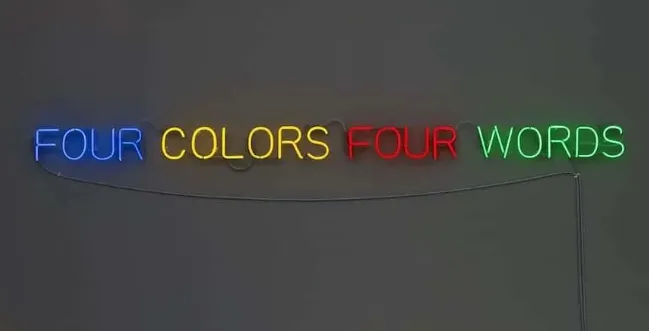
Joseph Kossus can be regarded as a pioneer of conceptual art, having established conceptual art in 1969 when he published Art After Physology in the magazine Studio International The basics. In fact, neon lights are a very important element in the work of this pioneer of conceptual art.
Kosuth’s clever visual summaries of complex topics involving semiotics and semantics made his work one of the defining works of the era, and paved the way for other artists to explore the relationship between art, color and language the way.
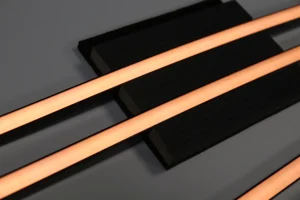
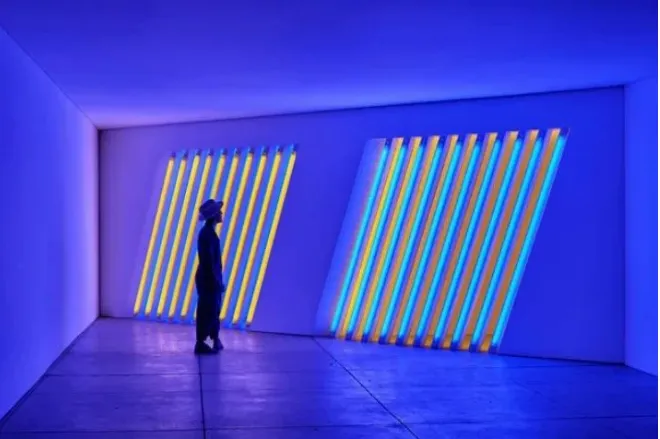
Another minimalist artist, Dan Flavin, is also a big fan of neon signs. Influenced by the environment at the time, Flavin’s early works were also dominated by abstract expressionist paintings. Until 1961, when he was working as a postman at the Guggenheim Museum, he became friends with artists Sol LeWitt and Robert Lyman. They encouraged him to use light tubes in his sculptures. Until 1963, he began to create entirely with new industrial fluorescent tubes and fixed light fixtures. This attempt is about to unlock his signature style
As his career progressed, Flavin continued to develop more ambitious, larger, site-specific installations. Flavin’s pioneering use of fluorescent lighting has made him known as the “Father of Neon Art” and inspired a number of influential artists such as Robert Irving and James Turrell.
Light, language, emotion
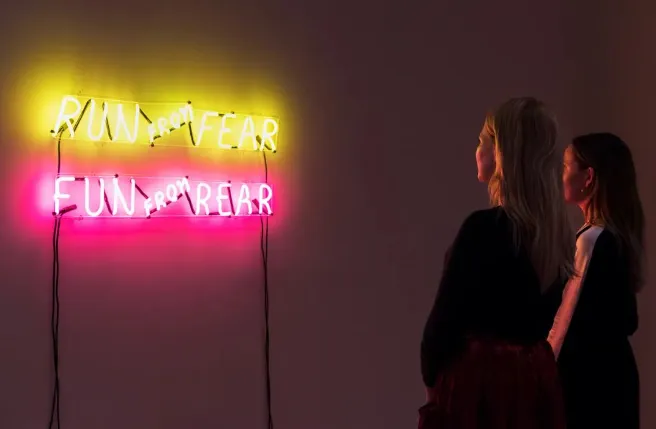
Compared with various contemporary works of art that are relatively obscure and rely heavily on contextual reading, there seems to be no obstacle to understanding neon art, just feel the strong visual impact it brings.
Neon and business
Today, with the rise of CYBERPUNK, neon lights are more widely used in commercial scenarios, and neon lights can present arbitrary shapes, making their application scenarios as small as bar decoration, as large as paid group exhibitions. Under the dull rhythm, in pursuit of fresh stimulation of the senses or enrichment of content on social media, people have gone to the bizarre neon. In the mottled phantom, I strated to know WHO I AM…