
















Recently, I saw a LED strip lifespan claim: A light strip with an eye-protection function is advertised as having a lifespan of 50,000 hours. Using it for 8 hours a day, 50,000 ÷ 8 ÷ 365 equals approximately 17 years. However, manufacturers typically only offer a 2-3 year warranty. Is this reasonable?
Whether it’s COB ambient light strips for home decoration without main lights, indoor dual-color temperature linear lights, or outdoor landscape lighting IP67 waterproof engineering light strips, most product specifications will state a light source lifespan of 50,000 hours. Many lighting designers, project purchasers, and homeowners are confused:
Based on 8 hours of daily use, 50,000 hours theoretically translates to 17 years, yet most light strip manufacturers only offer a 2-3 year warranty. The difference is huge. Is this a case of manufacturers misrepresenting specifications? Wilgex, with 18 years of experience in LED linear lighting strips and a 5000-square-meter standardized production plant, combines industry testing standards such as LM-80 and TM-21 to break down the difference between the nominal lifespan of LED strips and the overall warranty in layman’s terms, helping you avoid common mistakes in selecting lighting projects.
1. A 50,000-hour شريط LED lifespan cannot be taken literally.
Almost all neon flexible LED strips and wall washer linear lights on the market list a “50,000-hour” lifespan on their product pages. However, this number only represents the light decay time of the LED chips themselves and cannot be directly equated to the overall lifespan of the entire strip. To understand this number, it must be considered in conjunction with the luminous flux maintenance rating (L-value).
Most people judge the quality of an LED strip by whether the light is still bright. But the real standard in the lighting industry is the luminous flux maintenance rate—that is, how much the brightness of the strip has decreased after long-term operation. The industry standard uses three levels—L70, L80, and L90—to classify light decay standards:
* L90: Time taken for the light strip’s brightness to decay to 90% of its initial brightness.
* L80: Time taken for the light strip’s brightness to decay to 80% of its initial brightness.
* L70: Time taken for the light strip’s brightness to decay to 70% of its initial brightness.
A high CRI (Color Rendering Index) home lighting strip has an initial brightness of 1000 lumens when it leaves the factory. After a period of use, if the brightness drops to 900 lumens, its light decay parameter is L90; if it decays to only 700 lumens, then it’s L70.
Both are labeled as having a 50,000-hour lifespan, but the difference between L90 (50,000 hours) and L70 (50,000 hours) is significant. L90 means that after 50,000 hours, the light will still maintain 90% of its brightness, with extremely slow light decay, making it more suitable for long-term commercial lighting; while L70 only retains 70% of its brightness, and the dimming will be noticeable to the naked eye after prolonged use.
Therefore, if a product only states 50,000 hours without mentioning the corresponding L-grade, this parameter is essentially worthless. Directly converting it to “can be used for over ten years” can easily lead to problems.
2. The 50,000-hour lifespan is a laboratory estimate and differs significantly from real-world usage.
The 50,000-hour lifespan of LED strip lights is not actually measured through continuous lighting. The industry standard is to use an LM-80 long-term aging test to collect light decay data of the LEDs at different temperatures, then apply the TM-21 formula to calculate the theoretical long lifespan.
Moreover, this test environment is ideal—constant temperature, stable standard voltage, no humidity, no dust, and sufficient heat dissipation space. But where in real-world lighting projects can such ideal conditions be found? Outdoor exposure, enclosed spaces, voltage fluctuations… in actual use, the lifespan data will naturally be less favorable.
However, outdoor lighting strips and commercial lighting strips operate under complex environments: high temperatures and direct sunlight in summer, dampness and water accumulation during the rainy season, voltage fluctuations in the power grid, poor heat dissipation in enclosed ceilings, and corrosion from salt spray in coastal areas all significantly accelerate the overall aging of the strips, resulting in a lifespan far shorter than laboratory estimates.
3. LED chips are only one part of the light strip; other components are more prone to premature failure.
Many people mistakenly believe that the lifespan of a light strip is equal to the lifespan of the LED chips. In fact, linear light strips are a composite product, including not only LED chips but also a driver, FPC circuit board, waterproof sealing silicone, intelligent dimming IC, and aluminum heat dissipation components.
While LED chips themselves do have a slower light decay rate, the driver, control chip, and outer waterproof sealant age much faster. Outdoor light strips exposed to prolonged rain can cause seals to crack and leak; intelligent RGB color-changing light strips are susceptible to controller damage from voltage surges; and insufficient heat dissipation in enclosed ceilings accelerates power supply aging. A common scenario is that the LED chips are intact, but the driver burns out or the circuit short-circuits, rendering the entire light strip unusable.
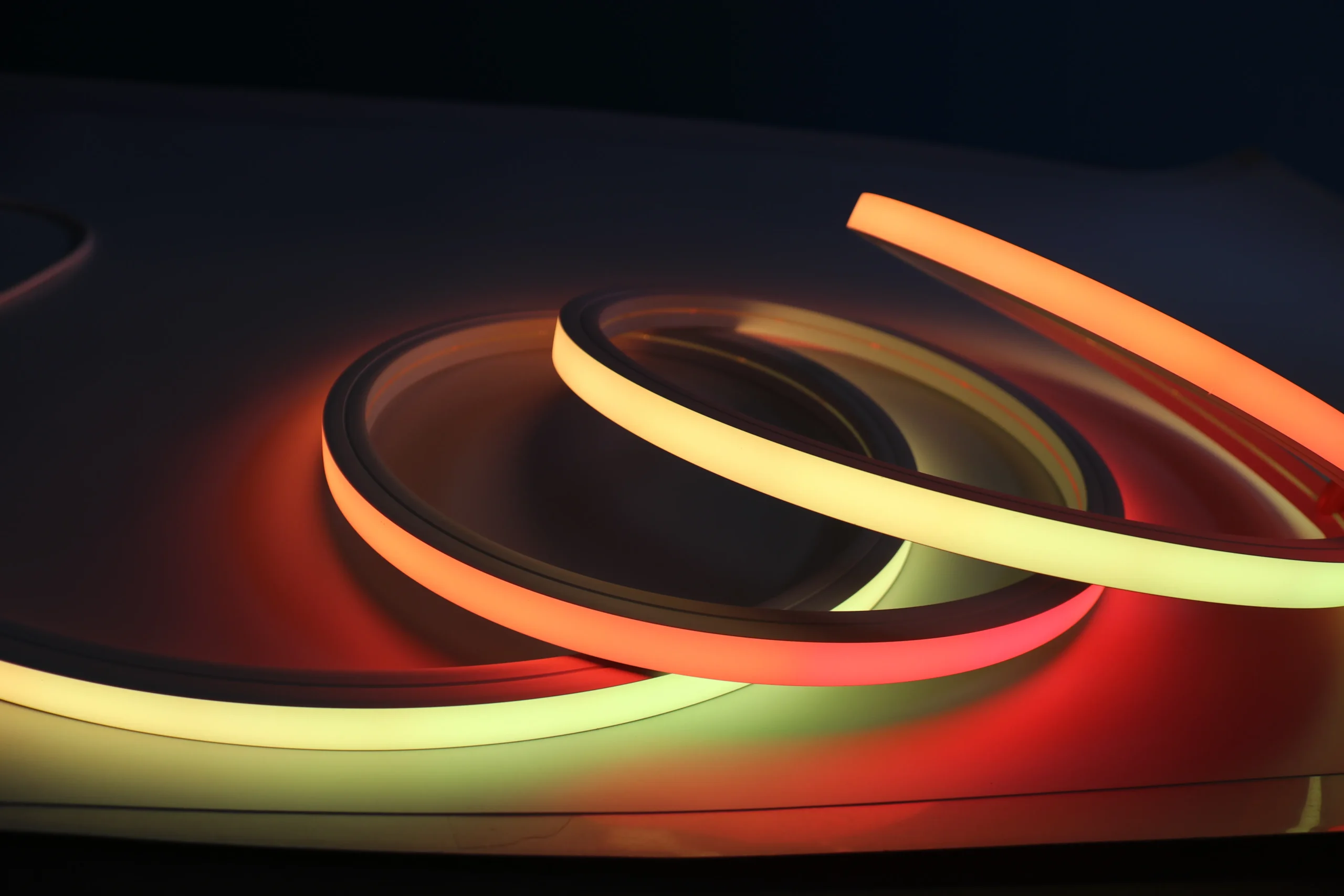
4. The warranty period is the manufacturer’s after-sales responsibility period, and it’s a different concept from the light source’s lifespan.
The warranty for LED light strips, simply put, is the period during which the manufacturer promises free repair and replacement. Manufacturers determine the warranty duration based on factors such as product failure rate, parts replacement costs, and the rate of wear and tear under different usage environments.
Therefore, you’ll find that even if the calculated lifespan of the LED chips reaches 50,000 hours, due to the rapid wear and tear of components in outdoor and commercial settings, manufacturers only offer a 2-3 year warranty for the entire unit. The warranty expiring doesn’t mean the light strip will immediately break down; it simply means the manufacturer will no longer cover after-sales repair costs.
Furthermore, warranty terms are generally categorized by usage scenario: indoor, dry home lighting strips have longer warranty periods, while those used for outdoor landscape lighting or high-temperature factory environments have shorter warranty periods. One more point to note—improper installation and overloading of electrical circuits will directly void the warranty.
5. When purchasing LED strip lights for engineering projects, pay close attention to these aspects when checking lifespan parameters:
* The L-level (L70/L80/L90) corresponding to 50,000 hours;
* Matching B-value (the failure rate of large-volume LED strip lights);
* Individual aging test data for the driver, sealant, and circuit board;
* The official warranty period and limited operating environment for the entire unit;
* Laboratory test temperature and current standards, matching the project’s on-site conditions. If a vendor only advertises a 50,000-hour lifespan without providing a complete optical testing report, the parameters are highly unreliable, and the lighting project is very likely to experience widespread light decay and repair failures later on.
Many engineering procurement personnel and interior lighting designers are easily misled by vendors’ claims of “50,000-hour ultra-long lifespan” when purchasing LED linear light strips, neglecting the L-level light decay rating, the warranty of the entire unit’s components, and real-world environmental degradation issues. Within just one or two years of project implementation, problems such as widespread dimming of the light strips, driver burnout, and water leakage occur, resulting in high repair costs.
Learn more about Wilgex LED Neon Lighting Solutions:
Website:
www.wilgex-led.com
Social Media:
www.facebook.com/WilgexLEDNeonFlex